Viser opslag med etiketten Experiment. Vis alle opslag

fredag den 10. maj 2013

Aquaponic update

Hello all,
been a bit quite as the spring here in Denmark has arrived and meant that any spare time went into whipping the the garden into shape.
So how fares the experimental aquaponic system?
It is doing very well, but also a bit disappointing.
Let me explain:
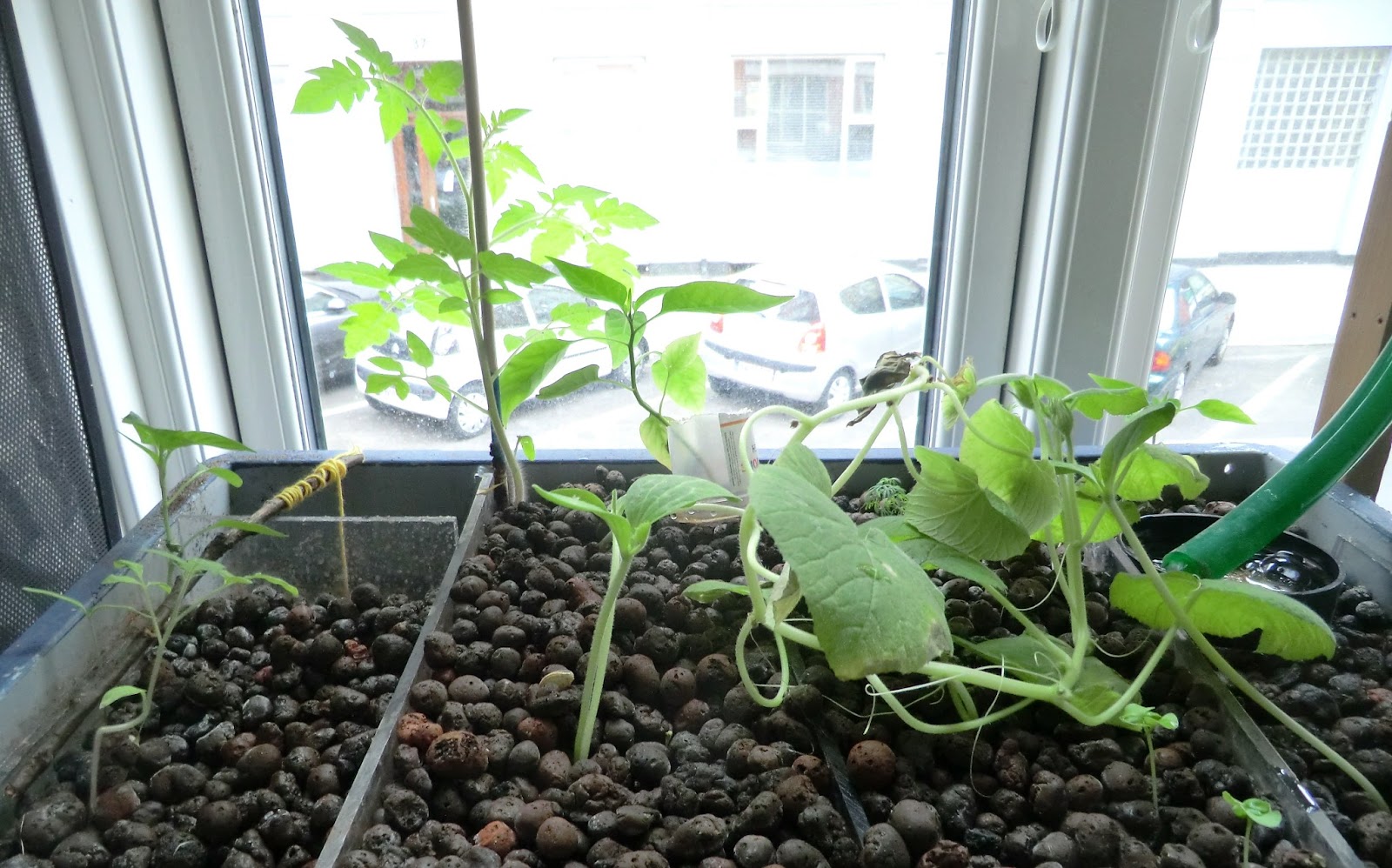
The Aquaponic system is doing well, plants are growing, and the fishtank is getting adequately cleaned in the process. So that is a success:
Aquaponic, window, indoor, experiment, tomatoes, fish, aquarium,
Plenty of fresh pants, enjoying the sun and nutrient-filled water. Tomatoes, Peber, Squash, Cucumber, and some strawberries (not healthy).

Aquaponic, window, indoor, experiment, tomatoes, fish, aquarium,

So why would I be a bit disappointed?
Well, in the next window I have my little tomato plant. and the plants there looks like this:

Aquaponic, window, indoor, experiment, tomatoes, fish, aquarium,
 Twice the height. And although they get perhaps ten minutes extra of sunlight, I had supposed/hoped that the aquaponic-system would have beaten this. But apperently not.
Aquaponic, window, indoor, experiment, tomatoes, fish, aquarium,
Even the new sprouts are doing better, without the fishies help.

So, not entirely satisfied with the system. But on the bright side - the tank is getting cleaned, the plants are growing adequately, and it has been a fun experiment.

All the best,
Kasper

fredag den 22. februar 2013

Cheap Nano Shrimp Experiment

Hello all,
Some months ago I set up a small Nano fishtank as an experiment.We had a large unused glass flower vase and I had a surplus of Neocaridina heteropoda (Red Cherry Shrimp, RCS) and I was interested in how well they would live in an unfiltered, small container without much food.

Cheap Nano Shrimp Experiment
 As it turns out they did excellent - they got almost no food and as a consequence the Shrimptank was kept crystal clear - no algae what so ever and the shrimps kept multiplying. And they did look nice on the table and was an interesting thing to observe while eating :-).

Cheap Nano Shrimp Experiment
 They had a bit of Java Moss and an Anubias for company and to provide some oxygen for them.

Cheap Nano Shrimp Experiment


Oh well, - if you happen to agree, disagree or be madly in love with me, please leave a comment or a tip :-). It really motivates all blogowners to keep blogging!

All the best,
Kasper

onsdag den 6. februar 2013

Aquaponics 22: Damping off problem and solution

Hello all,
So, as the problem of my 'depressed' plants continues I sought help at one of the best forums for all things aquaponic (Backyard Aquaponics). And lo and behold, one of the nice chaps there might have identified the problem.
It seems that the issue is caused by something called "Damping off". This disease causes plants to look fine one day and the next they will be depressingly sad. Their stalk will wilt away and the plant will drop or fall over. Exactly what I've been experiencing.

Damping off - Aquaponic plants looking fine 

One day the plants will look great...

Damping off - Aquaponic plant in a sorry state, but look at those roots!

And the next they will have turned into the above example of a very sorry state of being.

So, searching the internet I've read a lot about this disease. It appears to be a umbrella term for the horticultural disease or condition caused by a range of fungi.

I've narrowed my type of evil attacker down to either Rhizoctonia solani or Pythium spp:

Rhizoctonia root rot (Rhizoctonia solani) is a fungal disease which causes damping-off of seedlings and foot rot of cuttings.  Infection occurs in warm to hot temperatures and moderate moisture levels.  The fungi is found in all natural soils and can survive indefinitely.  Infected plants often have slightly sunken lesions on the stem at or below the soil line.  Transfer of the fungi to the germination room or greenhouse is easily accomplished by using outdoor gardening tools inside or vice versa.  The germination room should not be used for mixing potting soils or transplanting seedlings as a general rule.
Pythium Root Rot (Pythium spp.) is similar to Rhizoctonia in that it causes damping-off of seedlings and foot rot of cuttings.  However, infection occurs in cool, wet, poorly-drained soils, and by overwatering.  Infection results in wet odorless rots.  When severe, the lower portion of the stem can become slimy and black.  Usually, the soft to slimy rotted outer portion of the root can be easily separated from the inner core.  Species of Pythium can survive for several years in soil and plant refuse. 
Source: http://tomclothier.hort.net/page13.html

Wikipedia has this on Rhizoctonia solani
"a plant pathogenic fungus with a wide host range and worldwide distribution. This plant pathogen was discovered more than 100 years ago. Rhizoctonia solani frequently exists as thread-like growth on plants or in culture, and is considered a soil-borne pathogen. Rhizoctonia solani is best known to cause various plant diseases such as collar rot, root rot, damping off and wire stem. Rhizoctonia solani attacks its host(s) when they are in their juvenile stages of development such as seeds and seedlings, which are typically found in the soil. It makes sense then this saphrophytic pathogen would live and survive in the soil, and attack the part of its hosts that reside there. The pathogen is known to cause serious plant losses by attacking primarily the roots and lower stems of plants and although it have a wide range of hosts, their main targets are herbaceous plants. Rhizoctonia Solani would be considered a basidiomycete fungus if the teleomorph stage is abundant. and is currently not known to produce any asexual (conidia) spores although it is considered to have an asexual life cycle. Occasionally, sexual spores (basidiospores) are produced on infected plants. The disease cycle of Rhizoctonia solani is important in regards to management and control of the pathogen."

 So, I've got a nasty (and rightly feared) fungus attacking my plants. And it thrives in wet, cold poorly drained climates - a perfect discription of my growbed at the moment :-(.

SOLUTIONS / TREATMENT
There seems to be a couple of solutions (even though any type of pesticide is out of the question!) that I can try:
1) Lower the Ph of the Growbed. Bacteria and fungus dislike low levels of Ph.

2) Only plant well established seedlings. This would mean setting up a heated nursery or similar, whereby the more developed plants would be less susceptible to Damping Off.

I'll give solution number 1 a try first, as it does not involve buying anything expensive. An old and well tested way of lowering the Ph is the application of chamomile tea. This has long been known to be useful against bacteria attacks, which is due to its PH lowering abilities.
So, my plan of attack is to sow a new batch of plants, apply chamomile tea daily and see what happens. If I can detect an improvement (which should be easy) I'll carry on with this approach, and if not I'll try and set up a small heated nursery for the seedlings.

Anyways, sorry for the wall of text :-).

All the best,
Kasper

torsdag den 31. januar 2013

Installing a LED Moon Light in an Aquarium

Hello all,
A few years back, I bought a cheap LED Moon light system on Ebay. The reason for this was that my aquarium lamps are all set to switch off for a few hours around noon each day (where we are rarely at home). So I thought it might be nice to be able to see the fish swimming around without getting increased algae growth.
The installation was very simple, and it actually looked pretty good:


Unfortunately, the sucktion discs  wee not up to the task and after half a year they began regularly giving up and I had to pull the moon light out of the tank multiple times (it was water tight, of course).


The fish appeared to enjoy the light, swimming happily around, and it did remove some of the chock they experience when the main lights switch on.

All the best,
Kasper

onsdag den 30. januar 2013

Aquaponics 21: Scud Trap

Hello all,
When I added the three small grow beds (see here for details), I also snug a small sieve under the outlet. I wanted to see how much detritus, etc was carried along the system.

Aquaponic outlet and sieve

Yesterday, when I remembered and checked the sieve, it turned out that it had acted as a great Scud (Hyalella azteca) trap. Apparently the pump carry the scuds along the system and they've survived without problems. The sieve held about twenty fat scuds.

Scud trap

I left the sieve on a shelf for ten minutes and it turns out that ten minutes is long enough to turn live scuds into delicious (if you are a fish) dried scuds.

Drying scuds in the trap

So if you do not want scuds in your tanks, just leave them in a sieve for ten minutes, and then you are set. The fish ate them with great glee. This might also be the trick to use with slow eating fish (e.g. Betta Splendens (or Siamese Fighting Fish), giving them a chance to get some healthy live food.

All the best,
Kasper

mandag den 28. januar 2013

Easy way of catching shrimps II - free shrimp trap Mark II

Hello all,
I've already showed one simple type of trap that works well with catching shrimps (RCS), scuds and snails. Here is the designs for that one.
This is another type, even easier and perhaps cheaper. It works on the same principles, and the most difficult element in building one is to find a suitable stone :-). I prefer this one at the moment because it it is better at catching snails, and should a small curious fish get trapped (guppies are great at this) it is easier to liberate it.
Picture guide:
 Any type of plastic bottle is cut into two parts. A stone is put into the bottom part. The top is inserted into the bottom, tightly. And, presto, the trap is done.
 Put a few tasty morsels into the trap and within half an hour a bunch of shrimps, snails, and scuds will have colelcted inside it.

 This is after 45 minutes - at least twenty RCS shrimp, in addition to a few snails and scuds. That means it is feeding time for the larger fish :-).

All the best,
Kasper

What to feed Scuds (Hyallella azteca)

Hello all,

This post will consolidate the information I have gathered with regards to what the Scuds (Hyalella azteca) will eat, and what they seem to dislike.
 
So far the following foods have been tried and foudn adequate by the little crustaceans' taste buds:

Fish food: Any small dust from fish food containers, or crunbled larger flakes works well.

Fruit paste: Also works - and is eaten quickly.

Dried catfish pellets: They love these, and they should be packed with the correct nutrients. I've tried pellets with only vegetable contents and some with animal parts, and both appear to work. But I would suggest only using the vegetable ones, as they seem to pollute the water much less. Instead of just throwing them into the tank, I quickly grate mine. The fine powder seems to work better with the small scuds.

Leftover vegetables: I see my Scuds as soemthing of a waste disposal unit - so whenever my kids havn't eaten something I will give it a go. This has shown that cucumbers, tomatoes, and simialr food types works very well. As they float this will allow you to quickly assess whether or not the scuds are eating and how quickly. Cucumber seems a favourite, and anything containing veegtables appears to be a winner:


What they do not seem to enjoy eating:
Duck weed (all types of Lemnaceae), any plant not in the process of degrading, snails, shrimps, or any other thing alive.


If you have a suggestion, give me a shout and I'll try throwing it into the scud containers and see what happens :-).


Aquaponics 20: Failing at Aquaponics II

Hello all,

Things are not becoming the lush paradise I was hoping for...
Plants are growing fine, looking green and great, but only for a week or so and then they just give up on life and crumble.

Examples:


One day they are fine, the next they look like the above sorry specimen.


I've compiled a list of things I think could be causing this problem:
1) lack of sunlight? It is pretty dark here, but I do not think the plants would behave this way if it was a question of light.'
2) the water level or similar - the roots are wet and, again, wouldn't they turn yellow instead, if lack of water was the problem?
3) Temperature. I guess this is what is killing my plants. At the moment we are getting temperatures of -12 degrees and even though they are inside, the window is cold and the room temperature cannot adequately combat the temperature right next to the windows (especially as the heater is below the other window..).

So would plants suffering from a cold behave the way my plants are?

All the best,
Kasper

onsdag den 23. januar 2013

Easy way of catching shrimps - free shrimp trap

Hello all,
As known to everyone who has ever kept Red Cherry Shrimps (RCS) or any of their cousins, the Shrimp-experience goes something like this:

First month - why doesn't my Shrimps breed? Do they hate me? Are they dying? What Can I DO!
Second month - Wuhuu, success! They breed and they love me. I'm the best Shrimp-farmer ever!
Third month - Hmm, that is quite a lot of shrimps. I wonder what I should do...
Fourth month - AARGH! Shrimps everywhere, how do I get rid of them???

True story, more or less :-).

Beautiful red cherry shrimp

In my experience, once the RCS have established themselves they breed like rats and need serious culling (i.e. the process of removing breeding animals from a group). Now I've both sold and donated a lot of shrimps to other fish-keepers and have now begun using them as a natural source of food for my larger fish. This is all fine and great, but catching the little buggers can be quite a challenge, and after ruining an aqua scape several times I decided to get sneaky!

The following is the first shrimp trap I made and it functions very well. I'll be back in a couple of days with the other, larger trap I constructed later.
Again the concept was to use what ever I had in the house and you can use anything similar to the ingredients I used.
Shrimp trap
 This is the trap: A small plastic container (cleaned, of course), with a small hole cut from the top. I siliconed a small stone to the bottom to get it to sink to the bottom and a few strings to be able to easily extract the container again.
When a bit of food is put inside the container and it is left alone the shrimp will enter the opening, but will (because, lets face it, they are stupid) be unable to get out again.

Full shrimp trap
 This is the trap after an hours submersion - at least fifty shrimps have fallen for my trap :-). And all the hungry fish were soon mightily pleased!


All the best,
Kasper
Fruit paste as fish food?

Hello all,
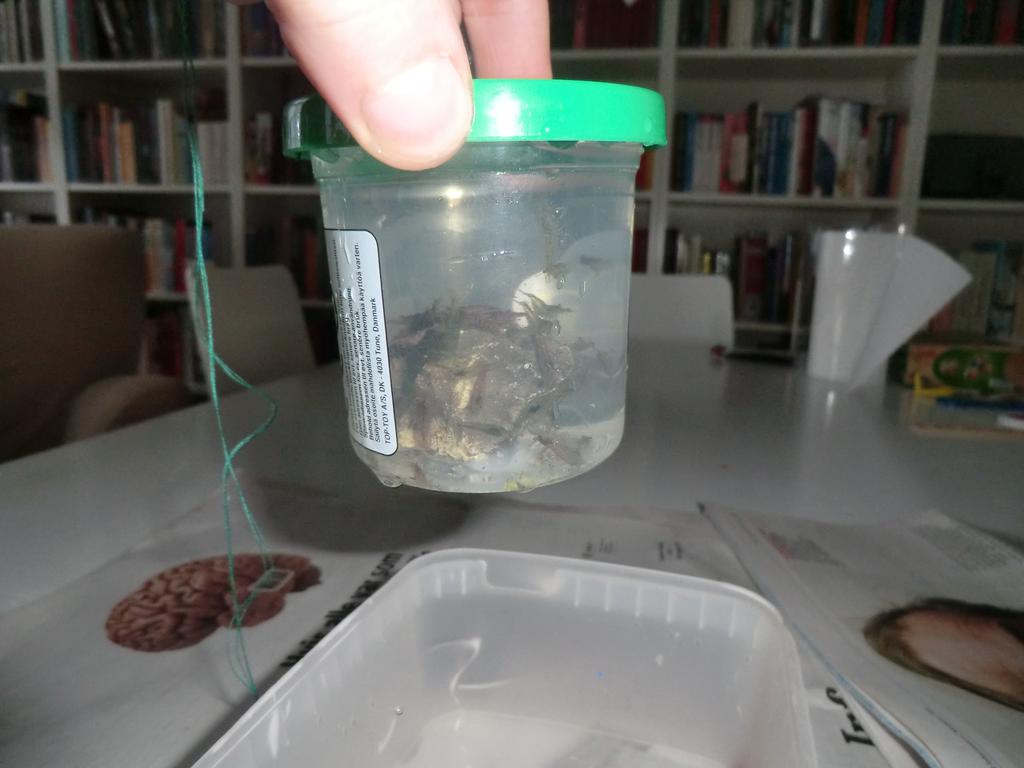
Well, apparently fish really like fruit paste :-).
As the stuff sinks, is full of good stuff, and is often not eaten by my kids, this is really nice - no more throwing it in the trash.


All the Best,
Kasper

tirsdag den 22. januar 2013

Slime mold in the Aquarium

Hello all,
I recently told the story of my experiences with marine fungus growing on a Red Moore root. This reminded me of another crazy visitor to my fishtanks (I sound like an old sailor...).
When I initially set up the large aquarium, I saw something weird after a few weeks.

After searching the net hard and far, it turns out that this visitor was not an algae or similar (which I initially thought) but a type of marine slime mold.
Apparently these are something of a mystery to everyone, but shouldn't harm the aquarium in any way. 

 Now, unfortunately for the average non-marine biologist, information on these weird growths are very difficult to get hold of. But they are neither plants, mushrooms, or alage. Instead they are thir own little box, of unrelated but similar beings, halfway between fungi and snail-like creatures. The various types of slime molds can be seen here on this thourough German homepage: http://www.schleimpilz-liz.de/index.php?option=com_content&view=category&id=26&Itemid=48&lang=de (that states it describes 'Die fabelhafte Welt der Schleimpilze' :-)). Schleimpilze, I guess that translates into Slime-sausages....
Oh, and they move. Each morning the thing would have shifted across the aquarium to a new location. Quite fascinating!
I had, through a friend who is a marine biologist, set up a meeting with a Dane who happens to know something about these molds, but it took so long that the thing had disappeared by then. I have not seen it in over a year, and I fear it died or was sucked into the pump or something similar.

Shame, I would have loved to find out which type it was.


Slime molds are best known from the study that proved that a single species might have casued ill-effects on Eel Grass (i.e. "Labyrinthula sp., a marine slime mold producing the symptoms of wasting disease in eelgrass, Zostera marina", by Muehlstein, Porter, & Short), a study that is available online (http://link.springer.com/article/10.1007%2FBF00392553?LI=true).

According to their abstract they state that "Coastal ecosystems along the eastern United States are presently threatened by a recurrence of the wasting disease of eelgrass, Zostera marina L. Using Koch's postulates, a species of the marine slime mold, Labyrinthula, is identified as the causal microorganism of this disease. Our disease tests for pathogenicity performed on eelgrass, using four Labyrinthula spp., indicate only one species produces the disease symptoms identical to those found associated with the wasting disease. The pathogenic Labyrinthula sp. has morphological characteristics that distinguish it from the other three species. Identification of Labyrinthula spp. is difficult because species described in the literature are not clearly characterized or identifiable. Tests at various salinities demonstrate that disease symptoms appear infrequently at salinities of 10%. or less."

 Also these videos by Princeton's John Bonner show just how amazing slime molds are:


 Cool stuff!


All the best,
Kasper

tirsdag den 15. januar 2013

Aquaponics 19: Making simple things complicated

Hello all,
So, the Aquaponic system had worked so far, i.e. no more water spilling all over the place and some growth. Not a lot, and the smaller sprouts seem to just give up hope, but others (peas and tomatoes) are growing nicely.
Seeing as I had nothing to do one Saturday morning I decided to try and make things complicated. A lot more complicated! So I bought three cheapo buckets (1$ each) and some pvc pipes and elbows (20$ worth) and set out to have some fun.
And so I've made the following 'hanging gardens of Copenhagen' - which for some reason amde my wife shake her head multiple times. In silence. Not sure if that was a good sign?
I'll be adding a new long hose that will transport the water from the fishtank, up the wooden stick and into the pvc pipe at the top. From there it should spill (in a controlled manner) into the buckets, and then progress into the growbed. I hope. So many things can go wrong with this. It is so much fun!

Aquaponic system - I'll use the entire windowsill yet!
 I've got to silicone the connections, wash more medium, and install the hose (8$), but apart from that it should be ready soon. Stay tuned for disaster updates :-).
Drilling holes is fun, when it works!
 I was a bit nervous that the flimsy sides of the cheap buckets would crack, but the hole-saw-thing made the job very easy.
Is it an elephant? No its a cheap growbed!
 And the entire pvc-experience was very fun - so easy to work with.
Cheap Standpipes
 I also needed some cheap standpipes for the buckets and decided these bottles would do the trick.

A DIY 'Das Boot'!
Meanwhile my son was up to no good - going "boooiiiiiing ..... boooooiiiiiing" for some reason :-).

Total costs skyrocketed this week, from 11$ to 42$! :-/.


For those not yet privy to the fascinating world of Aquaponics here is what information Wikipedia provides:

Aquaponicsis a sustainable food production system that combines a traditional aquaculture (raising aquatic animals such as snails, fish, crayfish or prawns in tanks) with hydroponics (cultivating plants in water) in a symbiotic environment. In aquaculture, effluents accumulate in the water, increasing toxicity for the fish. This water is led to a hydroponic system where the by-products from the aquaculture are filtered out by the plants as vital nutrients, after which the cleansed water is recirculated back to the animals. The term aquaponics is a portmanteau of the terms aquaculture and hydroponic.
Aquaponic systems vary in size from small indoor or outdoor units to large commercial units, using the same technology. The systems usually contain fresh water, but salt water systems are plausible depending on the type of aquatic animal and which plants. Aquaponic science may still be considered to be at an early stage, relative to other sciences.

Basicly, this translates into let the fish shit, let the plants grow on the shit and clean the water, and then eat all the plants yourself... more or less.... 

All the best,
Kasper

lørdag den 12. januar 2013

Pump intake gizmo, second try...

Hello all,
The pump is still making things difficult. There is no way of adjusting the waterflow, and I have nightmares of stuff overflowing. I created this gizmo the other day - this allows me to quite precisely control the waterintake:

 It is quite simple - the larger hose can be pulled back and forth, the number of holes it covers decides the intake - simple (free) but it works :-)


All the best,
Kasper

fredag den 11. januar 2013

Live food: Hyalella azteca (Scuds) love cucumber!

Hello all,
Just a quick update on the posts on how to keep and care for the lovely little Hyalella azteca (AKA scuds), posted here and here.
I just wanted to show just how much they love cucumbers (Cucumis sativus). these iages are taken ten minutes after the vegetables were served:
Hyalella azteca swarming the food
 I know there is not that much nutrients in cucumbers, but once in a while they should get a little treat :-).
Hyalella azteca swarming the food
This also had the added bonus of making it really easy to collect the fifty scuds I sold yesterday - I just scooped up the cucumber and let what seemed to be the correct amount drip into a jar :-).


All the best,
Kasper

torsdag den 10. januar 2013

Quick, free, DIY Grow box

Hello all,
I guessed I might need to sow some more developed seedlings rather than just throwing seeds all over the place and hoping for the best ;-).
Keeping to my rules of only using what I have around the apartment, I found two lids from tomatoes purchased from the supermarket. A quick application of Gaffa tape to make a lid and hey presto, we have ourselves a grow box. With a bit of cotton wadding on the bottom, light from the Aquaponic lamp and fishtank water misted on regularly, this works like a charm :-).

Free DIY Growth Box

Free DIY Growth Box

Free DIY Growth Box
Not pretty, but it works!

All the best,
Kasper

Guide to nutrient deficiency symptoms in plants

Hello all,
I found this somewhere on the net and thought I would share it.

Guide to Nutrient Deficiency symptoms - click to enlarge
 It quickly shows why your plants might be yellowing, withering or otherwise showing defieciency symptoms. When you've identified the illness, the cure is easy :-).

All the best,
Kasper

tirsdag den 8. januar 2013

Aquaponics 18: Hydroponic raft?

Hello all,
So while waiting for the Aquaponic plants to do some serious growth, I decided I might use the remaining space next to the system. I've only got one windowsill to experiment with, so might as well make the most of it :-).

I'm struggling with the nomenclature of this entire endeavour, but I believe a floating raft sucha s this one would be called 'hydroponic'?
Anyways, it was a pretty basic setup - in the future I'll complicate matters by making the bucket become the emergency draining system from the Aquaponic setup...

Step one: Bucket of slightly used fishwater (will eb changed weekly) - hopefully the plants can exist without added air?..
Step two: fancy floating thing found outside the supermarket...
Step three: find out that it wouldn't really support three potted plants (well, it did support three dry, potted plants but not three wet potted plants...)
Step four: create emergency flotation-system: More stuff from the crap-pile, taped together with plenty of LECA pellets inside, stuck underneath the fancy white thing above.

Step six: watch your creation float gracefully :-). Hope this works.


All the best,
Kasper
Related Posts Plugin for WordPress, Blogger...

Most popular posts