Viser opslag med etiketten 250 litres / 66 gallons Aquarium. Vis alle opslag
tirsdag den 15. april 2014
tirsdag den 19. februar 2013
mandag den 28. januar 2013
Aquarium plants in weird places: Ceratopteris thalictroides (water sprite) emersed
Hello all,
In one of my fish tanks I have an excellent 'corner filter' filtersystem. It works by having a large piece of foam where all the water is pulled through by a small powerhead. Works excellently, only needs cleaning once or twice a year, and can be camouflaged to disappear within the plants. It is in the right corner of the large image on the top of the page. Very nice filter (and quite cheap as well - I got mine from Unimati in Denmark).
Well, one of the interesting aspects of this filter is that it is raised a few centimeters above the water level. This means that there is a great place to grow emersed aquarium plantes, within the aquarium. And one day, when it was time to do some maintenance this plant had appeared:
It took me some time to identify it, especially so beacuse it looks different being emersed, than the normal specimens which are submersed. But it turns out it is a Ceratopteris thalictroides. A plant I do not otherwise have in the tank, so where it came from is a mystery :-).
Planted Tank states that it should be sued floating, but also that when it is grown emersed it will become quite sturdy: When grown emersed it will becomes sturdy with thicker stems and leaves. Growing submerged it adapt and turn into limp and softer plant. Water Sprite can be kept planted or left floating. Propagate by sending out axial shoots, forming tiny plantlets which eventually develop roots and floats away. Some sudden stress will encourage the plant propagate vigorously.
Which is also what I found to be the case. It appeared to love the intense heat and light levels just beneath the lamps.
Nice plant though, and when it grew enough to interfere with the light I planted it in one of the smaller tanks.
All the best,
Kasper
In one of my fish tanks I have an excellent 'corner filter' filtersystem. It works by having a large piece of foam where all the water is pulled through by a small powerhead. Works excellently, only needs cleaning once or twice a year, and can be camouflaged to disappear within the plants. It is in the right corner of the large image on the top of the page. Very nice filter (and quite cheap as well - I got mine from Unimati in Denmark).
Well, one of the interesting aspects of this filter is that it is raised a few centimeters above the water level. This means that there is a great place to grow emersed aquarium plantes, within the aquarium. And one day, when it was time to do some maintenance this plant had appeared:
It took me some time to identify it, especially so beacuse it looks different being emersed, than the normal specimens which are submersed. But it turns out it is a Ceratopteris thalictroides. A plant I do not otherwise have in the tank, so where it came from is a mystery :-).
Planted Tank states that it should be sued floating, but also that when it is grown emersed it will become quite sturdy: When grown emersed it will becomes sturdy with thicker stems and leaves. Growing submerged it adapt and turn into limp and softer plant. Water Sprite can be kept planted or left floating. Propagate by sending out axial shoots, forming tiny plantlets which eventually develop roots and floats away. Some sudden stress will encourage the plant propagate vigorously.
Which is also what I found to be the case. It appeared to love the intense heat and light levels just beneath the lamps.
Nice plant though, and when it grew enough to interfere with the light I planted it in one of the smaller tanks.
All the best,
Kasper
tirsdag den 22. januar 2013
Slime mold in the Aquarium
Hello all,
I recently told the story of my experiences with marine fungus growing on a Red Moore root. This reminded me of another crazy visitor to my fishtanks (I sound like an old sailor...).
When I initially set up the large aquarium, I saw something weird after a few weeks.
After searching the net hard and far, it turns out that this visitor was not an algae or similar (which I initially thought) but a type of marine slime mold.
Apparently these are something of a mystery to everyone, but shouldn't harm the aquarium in any way.
Now, unfortunately for the average non-marine biologist, information on these weird growths are very difficult to get hold of. But they are neither plants, mushrooms, or alage. Instead they are thir own little box, of unrelated but similar beings, halfway between fungi and snail-like creatures. The various types of slime molds can be seen here on this thourough German homepage: http://www.schleimpilz-liz.de/index.php?option=com_content&view=category&id=26&Itemid=48&lang=de (that states it describes 'Die fabelhafte Welt der Schleimpilze' :-)). Schleimpilze, I guess that translates into Slime-sausages....
Oh, and they move. Each morning the thing would have shifted across the aquarium to a new location. Quite fascinating!
I had, through a friend who is a marine biologist, set up a meeting with a Dane who happens to know something about these molds, but it took so long that the thing had disappeared by then. I have not seen it in over a year, and I fear it died or was sucked into the pump or something similar.
Shame, I would have loved to find out which type it was.
Slime molds are best known from the study that proved that a single species might have casued ill-effects on Eel Grass (i.e. "Labyrinthula sp., a marine slime mold producing the symptoms of wasting disease in eelgrass, Zostera marina", by Muehlstein, Porter, & Short), a study that is available online (http://link.springer.com/article/10.1007%2FBF00392553?LI=true).
According to their abstract they state that "Coastal ecosystems along the eastern United States are presently threatened by a recurrence of the wasting disease of eelgrass, Zostera marina L. Using Koch's postulates, a species of the marine slime mold, Labyrinthula, is identified as the causal microorganism of this disease. Our disease tests for pathogenicity performed on eelgrass, using four Labyrinthula spp., indicate only one species produces the disease symptoms identical to those found associated with the wasting disease. The pathogenic Labyrinthula sp. has morphological characteristics that distinguish it from the other three species. Identification of Labyrinthula spp. is difficult because species described in the literature are not clearly characterized or identifiable. Tests at various salinities demonstrate that disease symptoms appear infrequently at salinities of 10%. or less."
Also these videos by Princeton's John Bonner show just how amazing slime molds are:
Cool stuff!
All the best,
Kasper
I recently told the story of my experiences with marine fungus growing on a Red Moore root. This reminded me of another crazy visitor to my fishtanks (I sound like an old sailor...).
When I initially set up the large aquarium, I saw something weird after a few weeks.
After searching the net hard and far, it turns out that this visitor was not an algae or similar (which I initially thought) but a type of marine slime mold.
Apparently these are something of a mystery to everyone, but shouldn't harm the aquarium in any way.
Now, unfortunately for the average non-marine biologist, information on these weird growths are very difficult to get hold of. But they are neither plants, mushrooms, or alage. Instead they are thir own little box, of unrelated but similar beings, halfway between fungi and snail-like creatures. The various types of slime molds can be seen here on this thourough German homepage: http://www.schleimpilz-liz.de/index.php?option=com_content&view=category&id=26&Itemid=48&lang=de (that states it describes 'Die fabelhafte Welt der Schleimpilze' :-)). Schleimpilze, I guess that translates into Slime-sausages....
Oh, and they move. Each morning the thing would have shifted across the aquarium to a new location. Quite fascinating!
I had, through a friend who is a marine biologist, set up a meeting with a Dane who happens to know something about these molds, but it took so long that the thing had disappeared by then. I have not seen it in over a year, and I fear it died or was sucked into the pump or something similar.
Shame, I would have loved to find out which type it was.
Slime molds are best known from the study that proved that a single species might have casued ill-effects on Eel Grass (i.e. "Labyrinthula sp., a marine slime mold producing the symptoms of wasting disease in eelgrass, Zostera marina", by Muehlstein, Porter, & Short), a study that is available online (http://link.springer.com/article/10.1007%2FBF00392553?LI=true).
According to their abstract they state that "Coastal ecosystems along the eastern United States are presently threatened by a recurrence of the wasting disease of eelgrass, Zostera marina L. Using Koch's postulates, a species of the marine slime mold, Labyrinthula, is identified as the causal microorganism of this disease. Our disease tests for pathogenicity performed on eelgrass, using four Labyrinthula spp., indicate only one species produces the disease symptoms identical to those found associated with the wasting disease. The pathogenic Labyrinthula sp. has morphological characteristics that distinguish it from the other three species. Identification of Labyrinthula spp. is difficult because species described in the literature are not clearly characterized or identifiable. Tests at various salinities demonstrate that disease symptoms appear infrequently at salinities of 10%. or less."
Cool stuff!
All the best,
Kasper
tirsdag den 15. januar 2013
Fish spotlight: Chromaphyosemion bitaeniatum 'Ijebu Ode' (Killi fish, AKA Aphyosemion bitaeniatum))
Hello all,
if there is any one fish type that I really love then it would have to be the Killifish. Almost all of these (and there are thousands of different types) are beautiful, intriguing, and entertaining. One species I've really enjoyed having in my aquarium was the Chromaphyosemion bitaeniatum.
An unfussy eater, beautiful swimmer and very pleasing to the eye:
I bought my original trio at a Danish Killi-auction (ca. 3$) and instantly fell in love with them. Well, the entire family did, and the youngest even named them 'Dragon-fish'. They were from the region of Ijebu Ode.
I contacted the seller and it turned out that she had decided not to continue breeding the line and I got her remaining males for free. Wonderful lady!
Here the new Chromaphyosemion bitaeniatum males arrive - very curious.
Their larger brother goes closer to show them who is the boss!
Nothing beats Chromaphyosemion bitaeniatum males showing of against each other.
In general this is a very easy fish - eats anything and is very peaceful even with rivalling males sparring no injury will occur. The only downside is that you cannot expect mor than 1½ years out of them. But in that span of time they will charm anyone :-).
All the best,
Kasper
if there is any one fish type that I really love then it would have to be the Killifish. Almost all of these (and there are thousands of different types) are beautiful, intriguing, and entertaining. One species I've really enjoyed having in my aquarium was the Chromaphyosemion bitaeniatum.
An unfussy eater, beautiful swimmer and very pleasing to the eye:
| Male Chromaphyosemion bitaeniatum |
I bought my original trio at a Danish Killi-auction (ca. 3$) and instantly fell in love with them. Well, the entire family did, and the youngest even named them 'Dragon-fish'. They were from the region of Ijebu Ode.
I contacted the seller and it turned out that she had decided not to continue breeding the line and I got her remaining males for free. Wonderful lady!
Here the new Chromaphyosemion bitaeniatum males arrive - very curious.
Nothing beats Chromaphyosemion bitaeniatum males showing of against each other.
| Chromaphyosemion bitaeniatum and a Aphysemion Australe |
In general this is a very easy fish - eats anything and is very peaceful even with rivalling males sparring no injury will occur. The only downside is that you cannot expect mor than 1½ years out of them. But in that span of time they will charm anyone :-).
All the best,
Kasper
Mystery eggs
Hello all,
So there was a surprise waiting for me in the fishtank. Unfortunately I screwed up and destroyed it. *Insert sad face here*
Apparently someone has been busy and deposited a large patch of eggs at the back of the fishtank, on the root system of a small Pistia stratiotes. Sadly, I didn't notice until the plant had been out of the water for some time. At first I thought they might be from my Pterophyllum scalare, but now I think they might be snail eggs - as I havnt seen so much goo around fish eggs before.
There is a small colony of Marisa cornuarietis at large int he fish tank, they might be responsible.
Hmm, what might they be? Stay tuned as I investigate the case of the Mystery Eggs!
Anyways, I put the plant back again, but the eggs were soon eaten by hungry fish, now that they were not hidden in the background anymore.
EDIT: Well the case was solved a few days later - read the solution here...
All the best,
Kasper
So there was a surprise waiting for me in the fishtank. Unfortunately I screwed up and destroyed it. *Insert sad face here*
Apparently someone has been busy and deposited a large patch of eggs at the back of the fishtank, on the root system of a small Pistia stratiotes. Sadly, I didn't notice until the plant had been out of the water for some time. At first I thought they might be from my Pterophyllum scalare, but now I think they might be snail eggs - as I havnt seen so much goo around fish eggs before.
There is a small colony of Marisa cornuarietis at large int he fish tank, they might be responsible.
Hmm, what might they be? Stay tuned as I investigate the case of the Mystery Eggs!
Anyways, I put the plant back again, but the eggs were soon eaten by hungry fish, now that they were not hidden in the background anymore.
EDIT: Well the case was solved a few days later - read the solution here...
All the best,
Kasper
mandag den 14. januar 2013
Fish spotlight: Sturisoma aureum (Giant Whiptail, Golden Whiptail)
Hello all,
Roughly a year ago I got the chance to acquire three young catfish of the species Sturisoma aureum (AKA Giant Whiptail).Although we lost one fairly quickly, the remaining two have proven quite sturdy and have grown fast. This beautiful catfish, originally from Columbia but mine were bred locally (just a few kilometers from where I live by a talented lady), is a constant enjoyment. It almost never hides and I really wouldn't call it nocturnal as one often reads on the internet, instead it often rests on a leaf or on a treeroot in full view so we can always appreciate it. It is an excellent community fish, and a very elegant one, with its fancy elongated dorsal fin.
This is a video from when they were still fairly small - the largest is now more than 15 cm:
All in all a very pretty fish, and one that I really recommend!
From experience I can relate that they eat a fair bit of algae, but prefers catfish pellets and vegetables (peas, cucumber, etc).
Wikipedia adds the following:
Sturisoma aureum is a species of armored catfish endemic to Colombia where it is found in the Magdalena, San Jorge and Cesar River basins. This species grows to a length of 20 centimetres (7.9 in) SL. This species can be found in the aquarium trade.
All the best,
Kasper
Roughly a year ago I got the chance to acquire three young catfish of the species Sturisoma aureum (AKA Giant Whiptail).Although we lost one fairly quickly, the remaining two have proven quite sturdy and have grown fast. This beautiful catfish, originally from Columbia but mine were bred locally (just a few kilometers from where I live by a talented lady), is a constant enjoyment. It almost never hides and I really wouldn't call it nocturnal as one often reads on the internet, instead it often rests on a leaf or on a treeroot in full view so we can always appreciate it. It is an excellent community fish, and a very elegant one, with its fancy elongated dorsal fin.
| A beautiful Sturisoma aureum |
All in all a very pretty fish, and one that I really recommend!
| A young Sturisoma aureum |
From experience I can relate that they eat a fair bit of algae, but prefers catfish pellets and vegetables (peas, cucumber, etc).
Wikipedia adds the following:
Sturisoma aureum is a species of armored catfish endemic to Colombia where it is found in the Magdalena, San Jorge and Cesar River basins. This species grows to a length of 20 centimetres (7.9 in) SL. This species can be found in the aquarium trade.
All the best,
Kasper
onsdag den 2. januar 2013
And meanwhile not a single f*** was given :-)
Hello all,
Even though I'm ecstatic with my first radishes from the Aquaponic system, the big fish in my 250 liters tank called me over and told me to relax and feed them. And feed them something good.
After looking at them for a second I decided I had better, otherwise they would only gang up on me...
I really do not want to mess with those characters!
All the best,
Kasper
Even though I'm ecstatic with my first radishes from the Aquaponic system, the big fish in my 250 liters tank called me over and told me to relax and feed them. And feed them something good.
After looking at them for a second I decided I had better, otherwise they would only gang up on me...
| The Fish Hit Squad: Scalare, Whiptail, and Gourami |
All the best,
Kasper
Fish Spotlight: Hypseleotris compressa
Hello all,
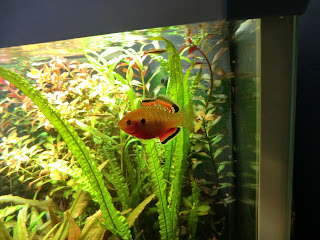
Found the place where I kept the pictures of my Hypseleotris compressa. This fish is full of character and, if treated well, will become an instant favorite of spectators. We've named our male "the red baron" (although my youngest just calls him the 'angry fish'). and he is among my favourite fish. Although their behaviour is not that impressive (they seem to be ambushers, i.e. they find a place and lie in wait for prey) and they will rarely take a swim through the aquarium they are always around, wathching you. And once you start feeding they come out and dazzle everyone with their colours (well the male does, the female is not that dazzling to be honest).
Mine take dry, flake food, but much prefer live food (i.e. daphnia, Hyalella azteca, RCS shrimps etc), but will happily munch on frozen mosquito etc. Somewhat slow feeders they have no problem bullying other fish away and our male has an area in the tank where no other fish go to feed.
All the best,
Kasper
Found the place where I kept the pictures of my Hypseleotris compressa. This fish is full of character and, if treated well, will become an instant favorite of spectators. We've named our male "the red baron" (although my youngest just calls him the 'angry fish'). and he is among my favourite fish. Although their behaviour is not that impressive (they seem to be ambushers, i.e. they find a place and lie in wait for prey) and they will rarely take a swim through the aquarium they are always around, wathching you. And once you start feeding they come out and dazzle everyone with their colours (well the male does, the female is not that dazzling to be honest).
Mine take dry, flake food, but much prefer live food (i.e. daphnia, Hyalella azteca, RCS shrimps etc), but will happily munch on frozen mosquito etc. Somewhat slow feeders they have no problem bullying other fish away and our male has an area in the tank where no other fish go to feed.
| Female Hypseleotris compressa |
| Female Hypseleotris compressa |
| Female Hypseleotris compressa |
All the best,
Kasper
lørdag den 29. december 2012
Dwarf Puffer tank - 5 gal nano tank
Hello all,
the last of the three nano tanks is devoted to the wonderful little dwarf puffer - Carinotetraodon travancoricus. This has got to be one of the most character-filled fish I've ever had the pleasure to observe. It does not swim - it floats :-).
Details: 20 l Dennerle Nano Aquarium, small Dennerle filter and 11W lamp. No heating.
Sulawesi Black gravel with a few roots etc.
Site:
Inhabitants:
Carinotetraodon travancoricus (Dwarf puffer):
Hymenochirus boettgeri (African dwarf frog)
Epiplatys annulatus
Older pictures:
All the best,
Tokasper
the last of the three nano tanks is devoted to the wonderful little dwarf puffer - Carinotetraodon travancoricus. This has got to be one of the most character-filled fish I've ever had the pleasure to observe. It does not swim - it floats :-).
| The tank today |
Details: 20 l Dennerle Nano Aquarium, small Dennerle filter and 11W lamp. No heating.
Sulawesi Black gravel with a few roots etc.
Site:
Inhabitants:
Carinotetraodon travancoricus (Dwarf puffer):
Hymenochirus boettgeri (African dwarf frog)
| Turned out these little froggies are the perfect tank mates for dwarf puffers... |
Epiplatys annulatus
![]() |
| The tank also used to house a small group of Epiplatys annulatus, but I couldnt keep them alive for longer than half a year. Beautiful fish. |
Older pictures:
All the best,
Tokasper
Abonner på:
Opslag (Atom)
Most popular posts
-
Hello all, the last of the three nano tanks is devoted to the wonderful little dwarf puffer - Carinotetraodon travancoricus . This has got...
-
Hello all, So one of the most interesting aspects of keeping fish, to me at least, is when they exhibit their natural hunting behaviour. A...
-
Hello all, I found this somewhere on the net and thought I would share it. Guide to Nutrient Deficiency symptoms - click to enlarge ...
-
Hello all, Some months ago I set up a small Nano fishtank as an experiment.We had a large unused glass flower vase and I had a surplus of ...
-
Hello all, So there was a surprise waiting for me in the fishtank. Unfortunately I screwed up and destroyed it. *Insert sad face here* Ap...
-
Hello all, So, as the problem of my 'depressed' plants continues I sought help at one of the best forums for all things aquaponic ...
-
Hello all, So while I would never have bought this fish myself, we have been trusted with its wellbeing while its owners are in the States...
-
Hello all, I recently told the story of my experiences with marine fungus growing on a Red Moore roo t. This reminded me of another crazy ...