Viser opslag med etiketten Fish spotlight. Vis alle opslag

søndag den 9. marts 2014

Mikrogeophagus ramirezi - Ram Chiclid

Hello all,
So while I would never have bought this fish myself, we have been trusted with its wellbeing while its owners are in the States for a few months.
So a Mikrogeophagus ramirezi - Ram Chiclid - in weird colouring... It is a weird fish, looks like an alien and is a very unnatural fish to see in the tank, but we've come to like it

Mikrogeophagus, ramirezi, Ram, Chiclid, care, tank, size, companions,

It is small, timid, but likes to hover in the corners, surveying the tank and waiting for a shrimp to pass by.


Our goby - Hypseleotris compressa - decided that the ram would be a suitable mating partner and tried to seduce him, not succesfully, but the pictures were fun as can be seen here.


An interesting fish, but not one I would buy myself due to its 'unnatural' colours.

All the best,
Kasper

tirsdag den 15. januar 2013

Fish spotlight: Chromaphyosemion bitaeniatum 'Ijebu Ode' (Killi fish, AKA Aphyosemion bitaeniatum))

Hello all,
if there is any one fish type that I really love then it would have to be the Killifish. Almost all of these (and there are thousands of different types) are beautiful, intriguing, and entertaining. One species I've really enjoyed having in my aquarium was the Chromaphyosemion bitaeniatum.

An unfussy eater, beautiful swimmer and very pleasing to the eye: 

Male Chromaphyosemion bitaeniatum


I bought my original trio at a Danish Killi-auction (ca. 3$) and instantly fell in love with them. Well, the entire family did, and the youngest even named them 'Dragon-fish'. They were from the region of Ijebu Ode.
I contacted the seller and it turned out that she had decided not to continue breeding the line and I got her remaining males for free. Wonderful lady!

Here the new Chromaphyosemion bitaeniatum males arrive - very curious.

Their larger brother goes closer to show them who is the boss!

Nothing beats Chromaphyosemion bitaeniatum males showing of against each other.


Chromaphyosemion bitaeniatum and a Aphysemion Australe

In general this is a very easy fish - eats anything and is very peaceful even with rivalling males sparring no injury will occur. The only downside is that you cannot expect mor than 1½ years out of them. But in that span of time they will charm anyone :-).

All the best,
Kasper

mandag den 14. januar 2013

Fish spotlight: Sturisoma aureum (Giant Whiptail, Golden Whiptail)

Hello all,
Roughly a year ago I got the chance to acquire three young catfish of the species Sturisoma aureum (AKA Giant Whiptail).Although we lost one fairly quickly, the remaining two have proven quite sturdy and have grown fast. This beautiful catfish, originally from Columbia but mine were bred locally (just a few kilometers from where I live by a talented lady), is a constant enjoyment. It almost never hides and I really wouldn't call it nocturnal as one often reads on the internet, instead it often rests on a leaf or on a treeroot in full view so we can always appreciate it. It is an excellent community fish, and a very elegant one, with its fancy elongated dorsal fin.
 
A beautiful Sturisoma aureum
This is a video from when they were still fairly small - the largest is now more than 15 cm:


All in all a very pretty fish, and one that I really recommend!

A young Sturisoma aureum

From experience I can relate that they eat a fair bit of algae, but prefers catfish pellets and vegetables (peas, cucumber, etc).


Wikipedia adds the following:
Sturisoma aureum is a species of armored catfish endemic to Colombia where it is found in the Magdalena, San Jorge and Cesar River basins. This species grows to a length of 20 centimetres (7.9 in) SL. This species can be found in the aquarium trade.


All the best,
Kasper

torsdag den 3. januar 2013

Fish Spotlight: Heterandria formosa - AKA least killifish, mosqu or midget livebearer

Hello all,
Once in a while you find that one of the fish you keep turns out to be a favourite although there is no good reason for this. The small Heterandria formosa is just such a fish. Unremarkable in colour, not a really good swimmer, and as small as you are likely to find any fish to be, it still is surprisingly lovable.

 So whats to love? Well, for one thing it breeds remarkably easily. As with guppies, it will keep throwing out babies (the smallest slivers that are barely visible). But it is also very, very, undemanding as it can tolerate temperatures from 5 to 30 degrees.
It is also just plain weird.
Size-wise, the male is less than half the size of the female.
The female will give birth to between one and three baies every three days or so, the only livebearer to do so, which is due to how the eggs mature. At our house it is sometimes referred to as the "rapist", the large 'genital' that is almost half the size of the male, can be swung around and used to perform "swim-by-rapes". The male can literally impregnate the female from afar. And will do so often and at every opportunity. As a consequence studies have shown that the female has developed an ability to eject semen from her body, but (gets weirder and weirder) also the ability to only do so with semen from fish that are too genetically close to her (i.e. 'brothers').


I've found them to unpecky eaters (they will eat anything they can get in their mouth) and will not, generally, eat their own offspring.
Easy, somehow adorable, fish. Highly recommended for small, possible low tech (i.e. no heater and filter) aquariums.

This is what Wikepedia has to offer:
Heterandria formosa (known as the least killifish, mosqu or midget livebearer) is a species of livebearing fish within the family Poeciliidae. This is the same family that includes familiar aquarium fishes such as guppies and mollies. H. formosa is not as commonly kept in aquaria as these species. H. formosa is one of the smallest fish in the world (7th smallest as of 1991), and is the smallest fish found in North America. Despite the common name "least killifish", it belongs to the family Poeciliidae and not to one of the killifish families.
Heterandria formosa is the only member of its genus to be found in the United States. Its range covers southeastern United States, from South Carolina south to Georgia and Florida, and through the Florida Gulf Coast to Louisiana. It is one of the few aquarium fishes to come from North America.
H. formosa lives primarily in vegetated, slow moving or standing freshwater but also occurs in brackish waters. 
Heterandria formosa is one of the smallest fish and smallest vertebrates known to science. Males grow to about 2 centimeters (0.8 inches), while females grow a little larger, to about 3 centimeters (1.2 inches).
The fish is generally an olive color, with a dark horizontal stripe through the center of the body. There is also a dark spot on the dorsal fin and females also have a dark spot on their anal fin. Like most poeciliids, males' anal fins are modified into a gonopodium that is used for impregnating females during mating.
 Like most poeciliids, H. formosa is a livebearer. The male uses his modified anal fin, or gonopodium, to deliver sperm to the female. The fertilized eggs grow within the female until they hatch, and the young are released free swimming. H. formosa has a unique breeding strategy even among livebearers. Rather than all the young being released at once, as many as 40 fry are released over a 10 to 14 day period, but occasionally over a longer period.


All the best,
Kasper

onsdag den 2. januar 2013

Fish Spotlight: Hypseleotris compressa

Hello all,
Found the place where I kept the pictures of my Hypseleotris compressa. This fish is full of character and, if treated well, will become an instant favorite of spectators. We've named our male "the red baron" (although my youngest just calls him the 'angry fish'). and he is among my favourite fish. Although their behaviour is not that impressive (they seem to be ambushers, i.e. they find a place and lie in wait for prey) and they will rarely take a swim through the aquarium they are always around, wathching you. And once you start feeding they come out and dazzle everyone with their colours (well the male does, the female is not that dazzling to be honest).
Mine take dry, flake food, but much prefer live food (i.e. daphnia, Hyalella azteca, RCS shrimps etc), but will happily munch on frozen mosquito etc. Somewhat slow feeders they have no problem bullying other fish away and our male has an area in the tank where no other fish go to feed.


Female Hypseleotris compressa

Female Hypseleotris compressa

Female Hypseleotris compressa


 All the best,
Kasper


lørdag den 29. december 2012

Fish Spotlight: Epiplatys annulatus (AKA Clown killi, Banded panchax, Pseudo-Epiplatys annulatus)

Hello all,

Used to have a small group of these wonderful little killies, Epiplatys annulatus. Alas they died one after the other over the course of half a year. One day I'll definately try them again, but this time in a larger tank and with much more 'cycled' content - I think they would really enjoy a heavily organic tank filled with insects of various types.

Pictures:
Epiplatys annulatus

Epiplatys annulatus

This is all Wikipedia has on this fish:
The Clown killi or Banded panchax (Epiplatys annulatus) is a species of African rivuline native to fresh water habitats in Guinea, Liberia and Sierra Leone in West Africa.

Here is a link to an article (in Danish) I wrote on this fish: http://www.akvariefisk.dk/species/show/?ArtID=15976

All the best,
Tokasper

Fish Spotlight: Betta Splendens - Siamese fighting fish

Hello all,
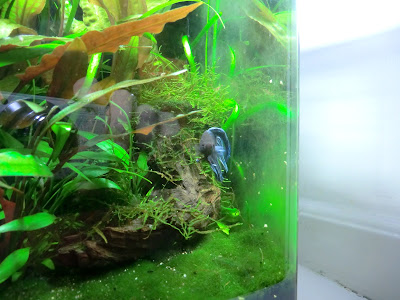
A few pictures of my fat male Betta splendens:
Betta Splendens - Siamese fighting fish
Betta splendens - don't mind the algae, this was just before I cleaned the tank :-)

Betta Splendens - Siamese fighting fish

Betta Splendens - Siamese fighting fish


Betta Splendens - Siamese fighting fish

Betta Splendens - Siamese fighting fish


Betta Splendens - Siamese fighting fish

Betta Splendens - Siamese fighting fish


If you should want to see where this blue beauty lives then this is its tank: http://fishtankdk.blogspot.dk/2012/12/cryptocoryne-country-20-l-nano-aquarium.html

Information from Wikipedia:

B. splendens usually grow to an overall length of about 3 inches, including fins. Although known for their brilliant colors and large, flowing fins, the natural coloration of B. splendens is a dull green and brown, and the fins of wild specimens are relatively short. Brilliantly colored and longer finned varieties (i.e. Veiltail; Delta; Superdelta; and Halfmoon) have been developed through selective breeding.
Properly kept and fed a correct diet, B. Splendens lives approximately 2-4 years in captivity but 5 is not uncommon. It is possible for them to live up to 10 years in rare cases.
The fish is a member of the gourami family (family Osphronemidae) of order Perciformes, but was formerly classified among the Anabantidae. Although there are nearly 50 other members of the Betta genus, B. splendens is one of the most popular species among aquarium hobbyists.
Betta Species also prefer a warmer water climate than other tropical fish - around 25-30 Degrees Celsius.(77-86 Degrees Fahrenheit)
Betta fish have an organ known as the labyrinth organ which allows them to breathe air at the water's surface. It is often wrongly thought that this organ allows Betta fish to be kept in unmaintained aquaria. This is a misconception as poor water quality makes all tropical fish, including Betta Splendens more susceptible to diseases such as fin rot.

The people of Siam and Malaya (now Thailand and Malaysia) are known to have collected these fish prior to the 19th century.
In the wild, bettas spar for only a few minutes or so before one fish backs off. Bred specifically for fighting, domesticated betta matches can go on for much longer, with winners determined by a willingness to continue fighting. Once one fish retreats, the match is over. Large amounts of money are wagered during these fights, with potential losses as great as a person's home.
Seeing the popularity of these fights, the king of Siam started licensing and collecting these fighting fish. In 1840, he gave some of his prized fish to a man who, in turn, gave them to Dr. Theodor Cantor, a medical scientist. Nine years later, Dr. Cantor wrote an article describing them under the name Macropodus pugnax. In 1909 the ichthyologist Charles Tate Regan, realizing that there was already a species with the name Macropodus pugnax, renamed the domesticated Siamese fighting fish Betta splendens.

Siamese fighting fish have upturned mouths and are primarily carnivorous surface feeders, although some vegetable matter may be eaten. In the wild, they feed on zooplankton, crustaceans, the larvae of mosquitoes and other water bound insect larvae. Typically, commercial betta pellets are a combination of mashed shrimp meal, wheat flour, fish meal, brine shrimp, bloodworms, and vitamins. These fish will also eat live or frozen bloodworms, mosquito larvae, brine shrimp, daphnia, small freshwater shrimp, and small fishes.
Hatching brine shrimp is a popular method used by many in the aquarium hobby to obtain live food for their Betta fish. Brine shrimp are the easiest live fish food to procure, hatch and cultivate and are particularly nutritious when the nauplii are in their early stages. Some aquarium fish are reluctant to accept dried or flake foods therefore live food is occasionally necessary.


All the best,
Tokasper

Fish Spotlight: Carinotetraodon travancoricus (AKA Dwarf Puffer)

Hello all,
A few pictures of my favorite little Dwarf Puffer:
Carinotetraodon travancoricus (AKA Dwarf Puffer)

Carinotetraodon travancoricus (AKA Dwarf Puffer) aquarium


The Puffer lives in this fish tank: http://fishtankdk.blogspot.dk/2012/12/puffer-tank-5-gal-nano-tank.html

Wikipedia provides the following information regarding Dwarf puffers:

The dwarf pufferfish, also known as the Malabar pufferfish, pea pufferfish or pygmy pufferfish, Carinotetraodon travancoricus is a small, freshwater pufferfish endemic to the River Pamba in Kerala, Southwest India. Maximum size is 22 mm (less than one inch), making it one of the smallest pufferfish in the world. Although closely related to marine pufferfish, they are not found in brackish or salt water, and reports to the contrary are based on misidentification

Both sexes are primarily yellow with dark green to black iridescent patches on the flanks and dorsal surface, but as with other members of the genus, sexual dimorphism is apparent in mature fish, with males being more brightly coloured than females. Males can also have a dark stripe down the center of their pale belly and iridescent "eye wrinkle" patterns that females lack.

Reproduction

Often dwarf pufferfish are plant-spawners, laying eggs in plants, including java moss in aquariums. Eggs have been seen to hatch after five days at 27 °C (81 °F), with fry initially feeding on infusoria, brine shrimp when they're a week old, and finally regular-sized food when possible. Dwarf pufferfish have also been known to scatter their eggs on the substrate hidden within vegetation. The eggs are fertilized externally. They do not guard their eggs or fry. After the eggs hatch, take out the fry; it is not recommended that you keep the adults and the fry together. A small tank of about ten gallons is acceptable.

Conservation

Dwarf pufferfish are not used as food but are traded as aquarium fish. It has been classified as "vulnerable" on the IUCN Red List due to changes in habitat and overharvesting for the aquarium trade.

Diet

The diet of dwarf pufferfish in the wild has not been reported, but other members of the genus feed on zooplankton and various benthic crustaceans and molluscs. Food items of specimens maintained in aquaria appears to be similar. In fact, the dwarf puffer is one of the few aquarium fish to regularly eat small live snails and can be useful in controlling snail populations (larger snails do not interest them).

Dwarf pufferfish in aquarium

Dwarf pufferfish have become quite popular as aquarium fish thanks to their attractive colours, small size, and relative ease of maintenance.Like all pufferfish, they can be aggressive, especially towards creatures smaller than themselves, and it is commonly recommended to keep them in a dedicated "species only" tank. A female to male ratio of 2 to 1 is sometimes recommended to reduce aggression in captive fish.
Despite what the fish stores may indicate, flake fish food is not a recommended diet for Dwarf Puffers, and many fish will refuse to take this food. If you are persistent, you may be able to feed them dried worms, and they will eat live (and frozen) bloodworms with relish. Puffers are notoriously messy eaters, it is therefore important not to overfeed, and to employ a good filtration system.
They may also eat small shrimp, or can be kept with them as some individuals may or may not eat shrimp kept in the same tank. Red ramshorn snails, Live & frozen bloodworms, brine shrimp, and triops are good foods for Dwarf Puffers.

All the best,
Tokasper
Related Posts Plugin for WordPress, Blogger...

Most popular posts