Hello all,
When I added the three small grow beds (see here for details), I also snug a small sieve under the outlet. I wanted to see how much detritus, etc was carried along the system.
Aquaponic outlet and sieve
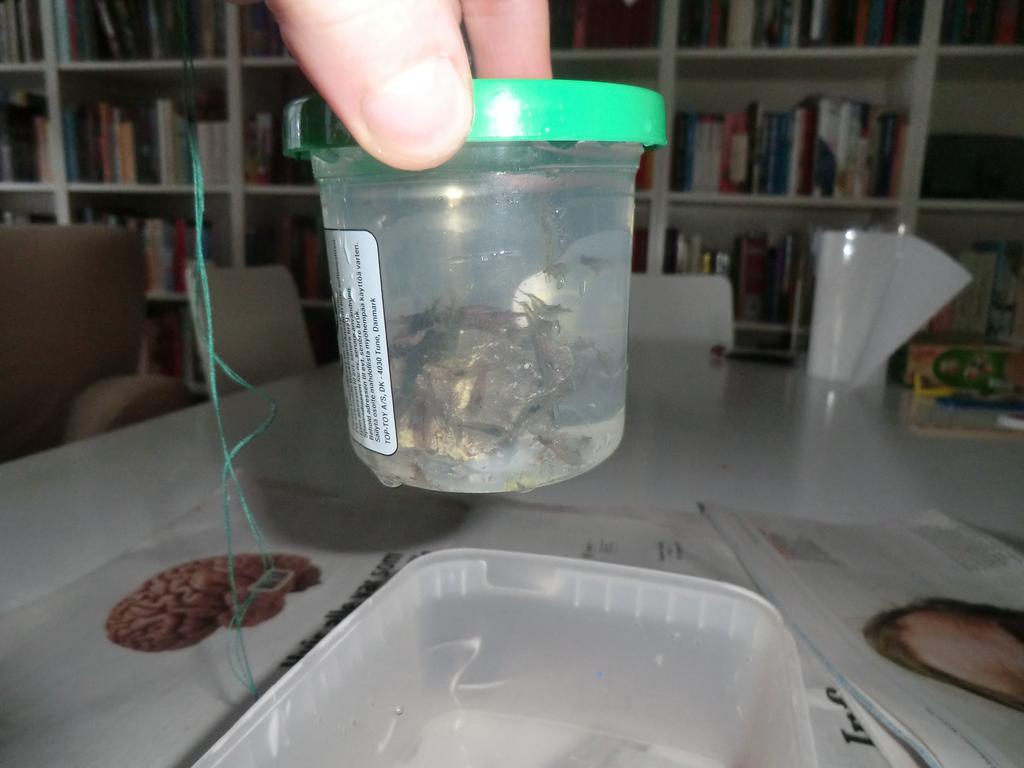
Yesterday, when I remembered and checked the sieve, it turned out that it had acted as a great Scud (Hyalella azteca) trap. Apparently the pump carry the scuds along the system and they've survived without problems. The sieve held about twenty fat scuds.
Scud trap
I left the sieve on a shelf for ten minutes and it turns out that ten minutes is long enough to turn live scuds into delicious (if you are a fish) dried scuds.
Drying scuds in the trap
So if you do not want scuds in your tanks, just leave them in a sieve for ten minutes, and then you are set. The fish ate them with great glee. This might also be the trick to use with slow eating fish (e.g. Betta Splendens (or Siamese Fighting Fish), giving them a chance to get some healthy live food.
Hello all,
I've already showed one simple type of trap that works well with catching shrimps (RCS), scuds and snails. Here is the designs for that one.
This is another type, even easier and perhaps cheaper. It works on the same principles, and the most difficult element in building one is to find a suitable stone :-). I prefer this one at the moment because it it is better at catching snails, and should a small curious fish get trapped (guppies are great at this) it is easier to liberate it.
Picture guide:
Any type of plastic bottle is cut into two parts. A stone is put into the bottom part. The top is inserted into the bottom, tightly. And, presto, the trap is done.
Put a few tasty morsels into the trap and within half an hour a bunch of shrimps, snails, and scuds will have colelcted inside it.
This is after 45 minutes - at least twenty RCS shrimp, in addition to a few snails and scuds. That means it is feeding time for the larger fish :-).
Hello all,
As known to everyone who has ever kept Red Cherry Shrimps (RCS) or any of their cousins, the Shrimp-experience goes something like this:
First month - why doesn't my Shrimps breed? Do they hate me? Are they dying? What Can I DO!
Second month - Wuhuu, success! They breed and they love me. I'm the best Shrimp-farmer ever!
Third month - Hmm, that is quite a lot of shrimps. I wonder what I should do...
Fourth month - AARGH! Shrimps everywhere, how do I get rid of them???
True story, more or less :-).
Beautiful red cherry shrimp
In my experience, once the RCS have established themselves they breed like rats and need serious culling (i.e. the process of removing breeding animals from a group). Now I've both sold and donated a lot of shrimps to other fish-keepers and have now begun using them as a natural source of food for my larger fish. This is all fine and great, but catching the little buggers can be quite a challenge, and after ruining an aqua scape several times I decided to get sneaky! The following is the first shrimp trap I made and it functions very well. I'll be back in a couple of days with the other, larger trap I constructed later. Again the concept was to use what ever I had in the house and you can use anything similar to the ingredients I used.
Shrimp trap
This is the trap: A small plastic container (cleaned, of course), with a small hole cut from the top. I siliconed a small stone to the bottom to get it to sink to the bottom and a few strings to be able to easily extract the container again. When a bit of food is put inside the container and it is left alone the shrimp will enter the opening, but will (because, lets face it, they are stupid) be unable to get out again.
Full shrimp trap
This is the trap after an hours submersion - at least fifty shrimps have fallen for my trap :-). And all the hungry fish were soon mightily pleased! All the best, Kasper
Hello all,
I've been asked how I actually collect or harvest the little Scuds (Hyalella azteca) when I need some to feed my fish. Well, there is a really easy and simple way of doing this - and you definately shouldn't try and catch them with a fishing net or similar as the little buggers are much too devious for such an approach.
This video shows how I do it:
By dropping a tasty piece of cucumber into the tank and waiting half an hour, the scuds will have found it and swarmed it.
And they really love cucumber:
You can then simply lift the cucumber out of the tank and let the scuds drip into whatever container you have available.
or feed them to your fish, who loves Scuds:
Now trying to count how many you've collected is a complete different problem, one that is close to impossible. I regularly sell portions of ca. 25 and its a hit and miss, so I generally collect far too many, just to avoid having to recount the amount.
Hello all,
Just a quick update on the posts on how to keep and care for the lovely little Hyalella azteca (AKA scuds), posted here and here.
I just wanted to show just how much they love cucumbers (Cucumis sativus). these iages are taken ten minutes after the vegetables were served:
Hyalella azteca swarming the food
I know there is not that much nutrients in cucumbers, but once in a while they should get a little treat :-).
Hyalella azteca swarming the food
This also had the added bonus of making it really easy to collect the fifty scuds I sold yesterday - I just scooped up the cucumber and let what seemed to be the correct amount drip into a jar :-). All the best, Kasper
Hello all,
Just a quick video that shows how my fish (well-fed already) goes ever so slightly crazy as the Hyalella azteca (scuds) that were shown here are poured into the aquarium :-).
Hoped you enjoyed that almost as much as the fish. More information on breeding, care and using as live food in freshwater aquariums, please click here.
Hello all,
So one of the most interesting aspects of keeping fish, to me at least, is when they exhibit their natural hunting behaviour. And they do not really do that when we only feed them dry flake food. And although flake food (probably) contains all the needed nutrients etc, nothing really compares to the content of live food. And when you feed your fishes live food you'll also get to see them hunt throughout the aquarium, searching and swallowing whatever they find. This makes for much more active fish, and thereby a much more entertaining aquarium. And when you add the bonus of the fish exhibiting much more bright colouring and general health, I really find nothing beats live food.
As it happens it can also be almost as interesting caring and breeding this food.
So all in all, I find it to be a natural choice to have some means of providing live food at least once a week.
I've several different types of live food, but one of my favourites is the Hyalella azteca, (also known as Scuds and Mexican freshwater fleas). These contain tons of nutrients and are also sufficiently difficult to catch that the fish will really have to work to get their food.
And they are also very fun to observe and very easy to breed and feed to your fish.
The following is how I maintain and use these little crustaceans, but I guess there is many more possibilities.
Two years ago I bought a small group of azteca from a seller on Ebay. And for a while I had almost given up on the little buggers as they didn't really grow, nor, did it seem, multiply.
I then turned to the following set-up which now provides an abundance of azteca - fully enough for a weekly feed.
The setup is basically two medium plastic containers (bought by my wife, intended to hold the children's toys, and cost about 5$ each). These are ca. 20 litres and large enough to hold to healthy colonies.
In each of these I've provided some cover - bits and pieces of hose pipe, some Leca pellets and whatever I had lying around that I deemed was safe to put in. The idea is simply to provide some cover for the scuds to live in.
Each of these tanks are unheated (averaging about 17-20 degrees depending on season), have no lighting (although they get a moderate amount of indirect sunlight) and are unfiltered. They get a small amount of fresh air each day (ca. two hours) through an air stone set to a moderate amount of bubbles.
Hyalella azteca set up 1
In one of the tanks I've added a lot of long green algae that I found behind one of my filters (it had direct sunlight and produced a lot of this stuff). The Scuds seems to love living in this.
Hyalella azteca set up2
In the other I deposit the filter wadding I use in my filters. I guess you could add new, shiny cotton wool, but instead of throwing the dirty filtergoo out I've experience with using this as food for the azteca.
Which brings me to how I feed these little buggers. Contrary to what I've read, they do not seem to be interested in eating plants. I've tried starving them and providing various types of living and dead plant leaves, vegetables etc and they seem generally uninterested in this type of food. What they really do appreciate (at least judging on their reproduction speed) is filter goo, sinking pellets intended for catfish, and dried fish food. Whenever I give them this type of food I'll see it quickly attacked by the scuds and quickly devoured.
A small group of very active and healthy azteca, ready to become fish food :-)
When it comes to using them as food, I normally just take one of the wads of filter wadding they live in (or a piece of the algae) and throw it in the fish tank. This results in most of them instantly trying to escape, much to the enjoyment of the fish who will hunt them. The rest will stay within their cover, which gives the slower fish a chance to 'graze' through the wadding, where they will stay for hours hoping to pick out a straddler or two. Afterwards the wadding or algae just goes back into the azteca tank.
I estimate a few survives each feeding, meaning most of my fish tanks have a healthy colony of azteca living in them, but I see this as a bonus. This provides a natural source of food within the tank, and the azteca should provide a health bonus by removing uneaten food and other goo. If you fear to have a living colony inside your tank, you could just collect the azteca (hold the wadding above a small tray and they will quickly drop into it) and let them die from lack of water (barbaric, but considering what their fate is I guess we shouldn't judge :-)).
This is what Wikipedia has to offer on azteca: Hyalella azteca is a widespread and abundant species of amphipod crustacean in North America. It reaches 3–8 mm (0.12–0.31 in) long, and is found in a range of fresh and brackish waters. It feeds on algae and diatoms and is a major food of waterfowl.