fredag den 18. april 2014

Clea helena (Assassin Snails) feeding frenzy

Hello all,
One of my Marisa cornuarietis ( a large, peaceful snail) was caught by a gang of assassin snails:

Clea, Helena, Assassin, Snail, eat, Marisa, cornuarietis, snail, aquarium

The Marisa must have been ill as they are normally elft alone by the assassin snails. But once one assassin had located the snail, the rest soon arrived and joined the feeding frenzy.

All the best,
Kasper

tirsdag den 15. april 2014

Large tank images

Hello all,
Just a few shots of life in the large tank (250l / 66 gallon):

Fish, tank, aquarium, 250l, 66, gallons, planted,

Fish, tank, aquarium, 250l, 66, gallons, planted,

Fish, tank, aquarium, 250l, 66, gallons, planted,


All the best,
Kasper

søndag den 9. marts 2014

Mikrogeophagus ramirezi - Ram Chiclid

Hello all,
So while I would never have bought this fish myself, we have been trusted with its wellbeing while its owners are in the States for a few months.
So a Mikrogeophagus ramirezi - Ram Chiclid - in weird colouring... It is a weird fish, looks like an alien and is a very unnatural fish to see in the tank, but we've come to like it

Mikrogeophagus, ramirezi, Ram, Chiclid, care, tank, size, companions,

It is small, timid, but likes to hover in the corners, surveying the tank and waiting for a shrimp to pass by.


Our goby - Hypseleotris compressa - decided that the ram would be a suitable mating partner and tried to seduce him, not succesfully, but the pictures were fun as can be seen here.


An interesting fish, but not one I would buy myself due to its 'unnatural' colours.

All the best,
Kasper

torsdag den 6. marts 2014

Prepping the garden - no more Aquaponics but good ol' spring is coming!

Hello all,
While the fishtanks are looking fine and provides great pleasure, it is time to get busy prepping for the short season we Danes call summer :-).

 Instead of the Aquaponic system, this year I've kept it simple and will use this nice tray I found (think it is from Ikea?) as a startersystem for this years harvest of tomatoes and basil.


It gets some heat from the aquarium underneath it and this also provides some moisture for the seedlings.


Once it gets a bit warmer outside these seedlings will be planted in the beds I built last year and have added something to tie the tomatoes to (last year was chaos as I hadn't anticipated the need for this...)


All the best,
Kasper

tirsdag den 4. marts 2014

Post Aquaponic Blues - 6 lessons from a year of indoor aquaponics

Hello all,
So as detailed on this blog, I've been experimenting with indoor aquaponics during the last year or so - if you missed a post or two, just click here!


To be succint - it was not the success I had hoped for and I've thus decided not to continue this year.
But I thought it might be prudent to share why I have reached this decision and what I learnt from my mistakes.

The setup was in a windowsill above a small aquarium (54 liters) and was made throguh recycled materials. The entire setup cost about 15$ - and was fun to build with the kids:


In the other windowsill was a "normal" kitchengarden, no aquaponic system but it did receive a bit more sunlight and this is what made me give up aquaponics. The normal garden gave as much produce as the aquaponic system.

So this experience taught me the following:

1) Aquaponics works - it was amazing to see things growing in clay - no soil what so ever.


2) As a filter the system worked and the aquarium was as clean (almost) as if there had been a filter.
but...

3) It is all about the sun - without adequate sunlight it means little to the plants if they have a ton of food to grow from. So either you need a great spot or a dedicated lamp, and this costs too much (in my opinion).


4) If it can leak, it will. I've had so many waterspills in the end it gave me bad dreams :-(. For anyone contemplating a similar setup - please remember that it will drip, spill or leak if at all possible. Use good materials and let the silicone dry for a looooong time - that way you may avoid the worst.

5) It is a very damp environment and new plants do not like it - I had a lot of diseased plants and while things grew well once established, the first few weeks were crucial.

  
6) The aquarium needs to be optimized for the system to work: little or no plants, overstocked amount of fish (preferable large) and this was not something I was willing to do to my fish - but should I do this again, I would choose some of the smaller Tanganikian chichlids, perhaps some Lamprologus ocellatus, who would thrive without plants.

So, it was fun to prove the concept to myself and friends, but in the end it was not 'worth' it and I've gone the more traditional route this year.

Anyways,
Good luck to anyone who tries this (and please do, it was a fun experience) and I hope the gods of aquaponics treats you well!

All the best,
Kasper


tirsdag den 18. februar 2014

Weird, forbidden, love - Ram Chiclid and Empire Gudgeon

Hello all,
Well, something weird occurred in the tank the other day. A visitor to the aquarium, a male Mikrogeophagus ramirezi whom we will babysit over the summer, apparently made our Hypseleotris compressa feel like a man.
I discovered the compressa making advances and showing the full, beautiful, colours that the males of this species get when in heat. The object turned out to be the Ram chiclid who really didn't know what to do. So the two males kept circling each other, while the compressa attempted to persuade the chiclid into some sweet love...
I only managed a few unfocused pictures and a brief video but it does make for interesting watching:

Mikrogeophagus, ramirezi, fish, love, forbidden, hypseleotris, compressa


Mikrogeophagus, ramirezi, fish, love, forbidden, hypseleotris, compressa


Mikrogeophagus, ramirezi, fish, love, forbidden, hypseleotris, compressa

Mikrogeophagus, ramirezi, fish, love, forbidden, hypseleotris, compressa

Mikrogeophagus, ramirezi, fish, love, forbidden, hypseleotris, compressa

Mikrogeophagus, ramirezi, fish, love, forbidden, hypseleotris, compressa

Mikrogeophagus, ramirezi, fish, love, forbidden, hypseleotris, compressa

Mikrogeophagus, ramirezi, fish, love, forbidden, hypseleotris, compressa


All the best,
Kasper

torsdag den 19. december 2013

Fun: My Cat fishing for fish in the Aquarium

Howdy all,
we recently acquired two kittens, and while they are fun and adorable, and all that, what really makes me alugh is when they try and get the fish through the glass fo the aquarium. they still havn't quite figured out that they won't be eating any of them anytime soon.
Here is a video of Tosca in action:


They have tried a few Shrimps and Guppies (who died when I forgot to empty a fishtrap :-/) and they ate those with great glee!

All the best,
Kasper

fredag den 10. maj 2013

Aquaponic update

Hello all,
been a bit quite as the spring here in Denmark has arrived and meant that any spare time went into whipping the the garden into shape.
So how fares the experimental aquaponic system?
It is doing very well, but also a bit disappointing.
Let me explain:
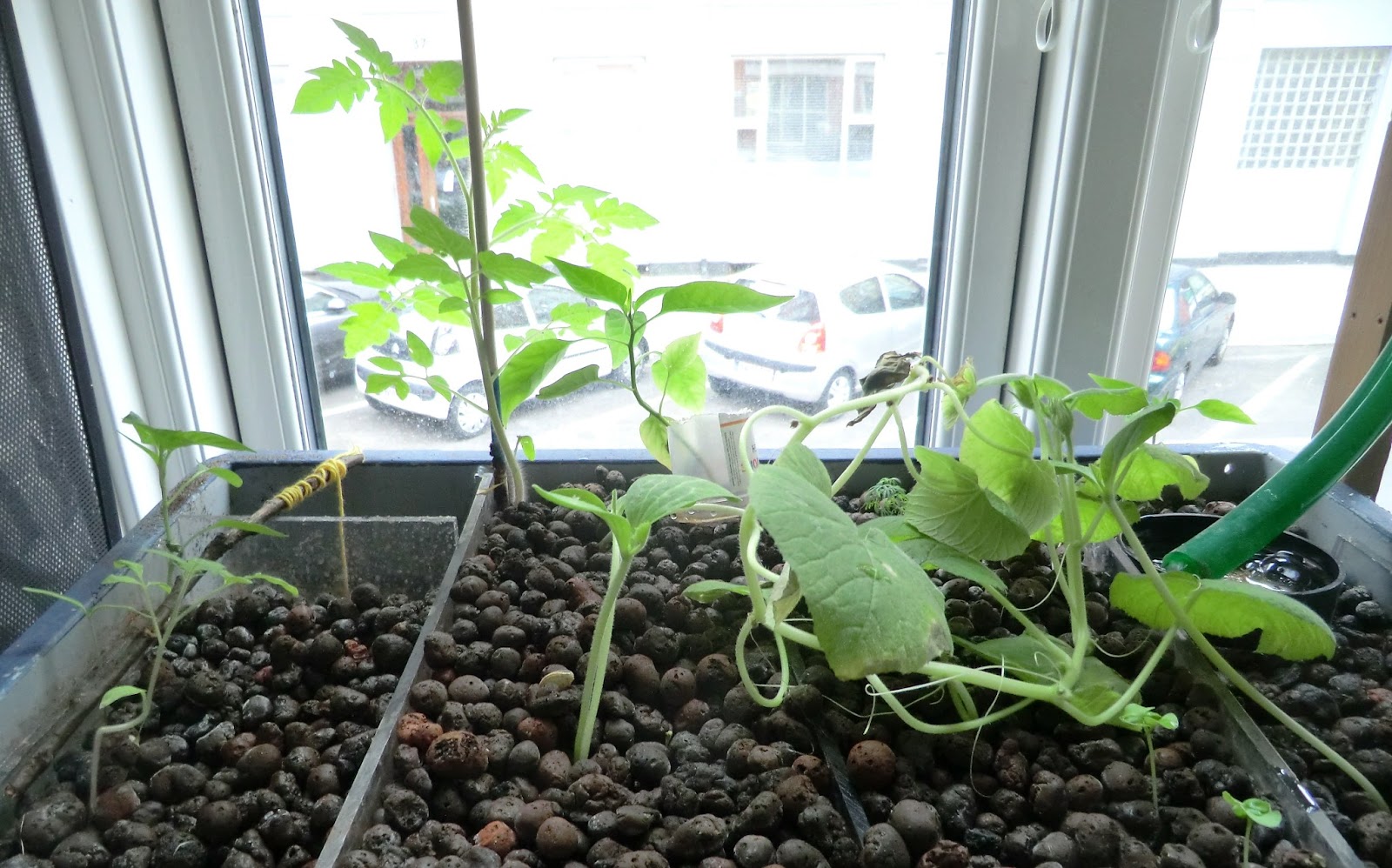
The Aquaponic system is doing well, plants are growing, and the fishtank is getting adequately cleaned in the process. So that is a success:

Aquaponic, window, indoor, experiment, tomatoes, fish, aquarium,
Plenty of fresh pants, enjoying the sun and nutrient-filled water. Tomatoes, Peber, Squash, Cucumber, and some strawberries (not healthy).

Aquaponic, window, indoor, experiment, tomatoes, fish, aquarium,

So why would I be a bit disappointed?
Well, in the next window I have my little tomato plant. and the plants there looks like this:

Aquaponic, window, indoor, experiment, tomatoes, fish, aquarium,
 Twice the height. And although they get perhaps ten minutes extra of sunlight, I had supposed/hoped that the aquaponic-system would have beaten this. But apperently not.
Aquaponic, window, indoor, experiment, tomatoes, fish, aquarium,
Even the new sprouts are doing better, without the fishies help.

So, not entirely satisfied with the system. But on the bright side - the tank is getting cleaned, the plants are growing adequately, and it has been a fun experiment.

All the best,
Kasper

søndag den 24. februar 2013

Wild plant growth

Hello all,
Took these pictures some time ago. We had been away for fourteen days, and this was the mildly insane plant growth that greeted me when I opened the 54 litres aquarium.

Fishtank plant growth vacation
Insane Growth

Seems the plants had been doing alright in our absence :-).

Fishtank plant growth vacation

The fish seemed to really enjoy the jungle.


All the best,
Kasper

fredag den 22. februar 2013

Cheap Nano Shrimp Experiment

Hello all,
Some months ago I set up a small Nano fishtank as an experiment.We had a large unused glass flower vase and I had a surplus of Neocaridina heteropoda (Red Cherry Shrimp, RCS) and I was interested in how well they would live in an unfiltered, small container without much food.

Cheap Nano Shrimp Experiment
 As it turns out they did excellent - they got almost no food and as a consequence the Shrimptank was kept crystal clear - no algae what so ever and the shrimps kept multiplying. And they did look nice on the table and was an interesting thing to observe while eating :-).

Cheap Nano Shrimp Experiment
 They had a bit of Java Moss and an Anubias for company and to provide some oxygen for them.

Cheap Nano Shrimp Experiment


Oh well, - if you happen to agree, disagree or be madly in love with me, please leave a comment or a tip :-). It really motivates all blogowners to keep blogging!

All the best,
Kasper

tirsdag den 19. februar 2013

Pterophyllum scalares snacking on cat fish pellets

Hello all,
Caught my greedy fish (two Hypseleotris compressa, and four Pterophyllum scalare) stealing the pellets intended for my Sturisoma aureum and thought I would share. At least they got some vegetables :-).


Pterophyllum scalares snacking on cat fish pellets
Culprit number 1
Hypseleotris compressa snacking on cat fish pellets
Culprit number 2

All the best,
Kasper

onsdag den 6. februar 2013

Aquaponics 22: Damping off problem and solution

Hello all,
So, as the problem of my 'depressed' plants continues I sought help at one of the best forums for all things aquaponic (Backyard Aquaponics). And lo and behold, one of the nice chaps there might have identified the problem.
It seems that the issue is caused by something called "Damping off". This disease causes plants to look fine one day and the next they will be depressingly sad. Their stalk will wilt away and the plant will drop or fall over. Exactly what I've been experiencing.

Damping off - Aquaponic plants looking fine 

One day the plants will look great...

Damping off - Aquaponic plant in a sorry state, but look at those roots!

And the next they will have turned into the above example of a very sorry state of being.

So, searching the internet I've read a lot about this disease. It appears to be a umbrella term for the horticultural disease or condition caused by a range of fungi.

I've narrowed my type of evil attacker down to either Rhizoctonia solani or Pythium spp:

Rhizoctonia root rot (Rhizoctonia solani) is a fungal disease which causes damping-off of seedlings and foot rot of cuttings.  Infection occurs in warm to hot temperatures and moderate moisture levels.  The fungi is found in all natural soils and can survive indefinitely.  Infected plants often have slightly sunken lesions on the stem at or below the soil line.  Transfer of the fungi to the germination room or greenhouse is easily accomplished by using outdoor gardening tools inside or vice versa.  The germination room should not be used for mixing potting soils or transplanting seedlings as a general rule.
Pythium Root Rot (Pythium spp.) is similar to Rhizoctonia in that it causes damping-off of seedlings and foot rot of cuttings.  However, infection occurs in cool, wet, poorly-drained soils, and by overwatering.  Infection results in wet odorless rots.  When severe, the lower portion of the stem can become slimy and black.  Usually, the soft to slimy rotted outer portion of the root can be easily separated from the inner core.  Species of Pythium can survive for several years in soil and plant refuse. 
Source: http://tomclothier.hort.net/page13.html

Wikipedia has this on Rhizoctonia solani
"a plant pathogenic fungus with a wide host range and worldwide distribution. This plant pathogen was discovered more than 100 years ago. Rhizoctonia solani frequently exists as thread-like growth on plants or in culture, and is considered a soil-borne pathogen. Rhizoctonia solani is best known to cause various plant diseases such as collar rot, root rot, damping off and wire stem. Rhizoctonia solani attacks its host(s) when they are in their juvenile stages of development such as seeds and seedlings, which are typically found in the soil. It makes sense then this saphrophytic pathogen would live and survive in the soil, and attack the part of its hosts that reside there. The pathogen is known to cause serious plant losses by attacking primarily the roots and lower stems of plants and although it have a wide range of hosts, their main targets are herbaceous plants. Rhizoctonia Solani would be considered a basidiomycete fungus if the teleomorph stage is abundant. and is currently not known to produce any asexual (conidia) spores although it is considered to have an asexual life cycle. Occasionally, sexual spores (basidiospores) are produced on infected plants. The disease cycle of Rhizoctonia solani is important in regards to management and control of the pathogen."

 So, I've got a nasty (and rightly feared) fungus attacking my plants. And it thrives in wet, cold poorly drained climates - a perfect discription of my growbed at the moment :-(.

SOLUTIONS / TREATMENT
There seems to be a couple of solutions (even though any type of pesticide is out of the question!) that I can try:
1) Lower the Ph of the Growbed. Bacteria and fungus dislike low levels of Ph.

2) Only plant well established seedlings. This would mean setting up a heated nursery or similar, whereby the more developed plants would be less susceptible to Damping Off.

I'll give solution number 1 a try first, as it does not involve buying anything expensive. An old and well tested way of lowering the Ph is the application of chamomile tea. This has long been known to be useful against bacteria attacks, which is due to its PH lowering abilities.
So, my plan of attack is to sow a new batch of plants, apply chamomile tea daily and see what happens. If I can detect an improvement (which should be easy) I'll carry on with this approach, and if not I'll try and set up a small heated nursery for the seedlings.

Anyways, sorry for the wall of text :-).

All the best,
Kasper

mandag den 4. februar 2013

The case of the mysterious eggs solved!

Hello all,
I recently detailed the case of the mysterious eggs (re-read it here) that I was not sure whether they belonged to my Pterophyllum scalare or to one of the Marisa cornuarietis snails roaming the aquarium.

Well consider the case solved!

It was not these guys:

Pterophyllum scalare not laying eggs


Nope the culprit was indeed the Marisa snails. I caught one in the act of depositing eggs and they indeed do look identical:
Marisa cornuarietis laying eggs


Marisa cornuarietis laying eggs
In this picture it even looks like the scalare is pointing the culprit out, perhaps to get its name cleared :-)

Marisa cornuarietis laying eggs while the Pterophyllum scalare draws attention
All the best,
Kasper

torsdag den 31. januar 2013

Installing a LED Moon Light in an Aquarium

Hello all,
A few years back, I bought a cheap LED Moon light system on Ebay. The reason for this was that my aquarium lamps are all set to switch off for a few hours around noon each day (where we are rarely at home). So I thought it might be nice to be able to see the fish swimming around without getting increased algae growth.
The installation was very simple, and it actually looked pretty good:


Unfortunately, the sucktion discs  wee not up to the task and after half a year they began regularly giving up and I had to pull the moon light out of the tank multiple times (it was water tight, of course).


The fish appeared to enjoy the light, swimming happily around, and it did remove some of the chock they experience when the main lights switch on.

All the best,
Kasper

onsdag den 30. januar 2013

Aquaponics 21: Scud Trap

Hello all,
When I added the three small grow beds (see here for details), I also snug a small sieve under the outlet. I wanted to see how much detritus, etc was carried along the system.

Aquaponic outlet and sieve

Yesterday, when I remembered and checked the sieve, it turned out that it had acted as a great Scud (Hyalella azteca) trap. Apparently the pump carry the scuds along the system and they've survived without problems. The sieve held about twenty fat scuds.

Scud trap

I left the sieve on a shelf for ten minutes and it turns out that ten minutes is long enough to turn live scuds into delicious (if you are a fish) dried scuds.

Drying scuds in the trap

So if you do not want scuds in your tanks, just leave them in a sieve for ten minutes, and then you are set. The fish ate them with great glee. This might also be the trick to use with slow eating fish (e.g. Betta Splendens (or Siamese Fighting Fish), giving them a chance to get some healthy live food.

All the best,
Kasper
Related Posts Plugin for WordPress, Blogger...

Most popular posts